

Blog 
What is SMS marketing and where to use it?
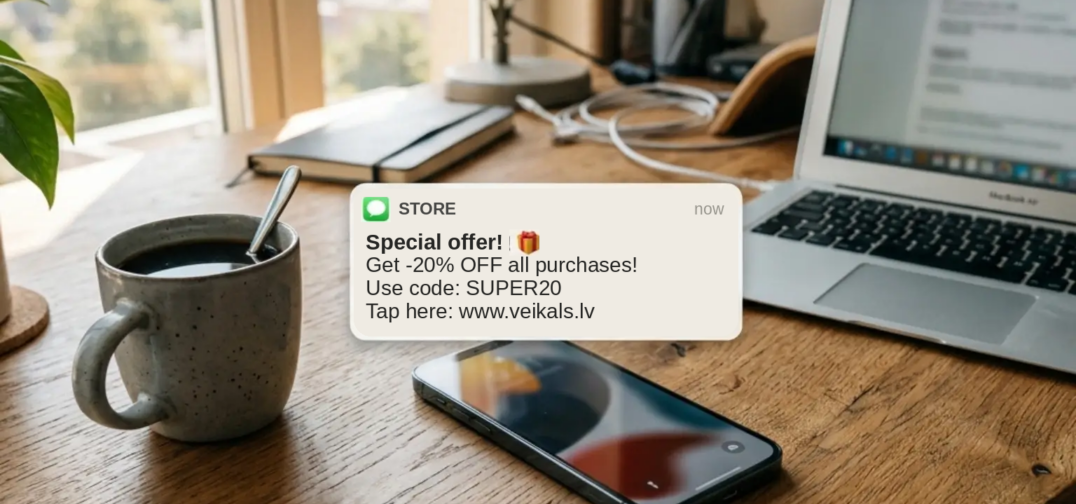
Businesses reach their customers through several channels, including email, social media, Google Ads and SMS, and each one serves a different purpose. SMS stands out for its speed. Most text messages are read within the first few minutes, which makes it the right channel whenever a customer needs to receive information without delay.
In this article, we explain how SMS marketing works, where it delivers the best results, and what to consider when planning an SMS campaign for your business.
Why SMS marketing is effective
Around 99% of the text messages a business sends arrive on the recipient’s phone, and roughly 90% of those are read within three minutes. This makes SMS one of the fastest ways to notify or inform a customer.
Email serves a different purpose. It is better suited to longer messages that can include images, detailed content and links to several products at once. The two channels complement each other. SMS is used for short, time-sensitive information, while email carries the more detailed content that customers read at a time that suits them.
Where SMS marketing delivers the best results
SMS suits almost any industry, but it produces particularly strong results in certain sectors.
Online stores and e-commerce
In online stores, SMS is an effective tool for recovering abandoned carts, because the reminder arrives while the customer is still considering the product and their initial interest has not faded. It is also used for order confirmations, delivery updates and promotions with a clear deadline.
Beauty salons, gyms and service providers
Appointment reminders reduce the number of customers who do not attend. When a customer cancels at short notice, the system can automatically notify others on the waiting list and offer them the slot, which increases the chance that it is filled the same day.
Healthcare and dentistry
Reminders about an upcoming appointment reduce missed visits by around 30% to 40%. If a doctor falls ill or a piece of equipment breaks down, a patient who is informed in time usually reschedules and stays with the same practice. A patient who arrives to find the doors closed, however, usually chooses a different specialist.
Universities and education
Universities and training providers use SMS to inform students about timetable changes and last-minute room changes, and to send links to online lectures. Email is less effective here, because many students check it only once a day or less.
Event organisers
Event organisers use SMS to send reminders before an event and to communicate changes while it is taking place. If a conference venue changes at short notice, SMS is the only channel through which every attendee notices the message immediately.
Logistics and delivery
SMS informs the recipient when a delivery is due. This reduces the number of cases where a courier arrives but no one is home, because the customer can respond in advance and change the delivery time or address if needed.
Financial services
Banks, insurers and other financial companies use SMS to send one-time passcodes (OTP) for two-factor authentication, to confirm payments and to remind customers when an invoice is due. In this sector, SMS has become a standard method for protecting customer accounts and reducing late payments.
The main ways to use SMS marketing
Regardless of the industry, SMS marketing can be divided into four main uses, depending on the company’s goal.
Sales
SMS supports sales by quickly informing customers about new products, seasonal discounts and limited-time promotions. When a promotion lasts only 24 or 48 hours, SMS ensures that customers learn about it in time.
Customer information
SMS reduces the workload of your customer service team. Customers receive their order confirmation, delivery notice and appointment reminder automatically, so they do not need to contact you by phone or email for updates.
Customer retention
SMS keeps you in regular contact with existing customers through loyalty offers, birthday discounts and campaigns aimed at bringing inactive customers back. Retaining an existing customer costs a business around 5 to 7 times less than acquiring a new one.
Account protection
Businesses also use SMS to send one-time passcodes for two-factor authentication, password reset links and alerts about unusual account activity. On any platform where users carry out financial transactions or manage personal data, these messages have become standard.
The most common SMS marketing mistakes
Sending messages too often
If a customer receives a message almost every day, they will unsubscribe. A reasonable frequency is 2 to 4 messages per month, depending on the industry and the goal of the communication.
Sending messages with no call to action
If a message has no link, no date and no specific action for the customer to take, it will be ignored. Every message needs a clear call to action, for example a link to the product or a specific promotion deadline.
Sending the same message to everyone
If you send the same message to your entire list, the offer reaches many people for whom it is not relevant. Dividing your contacts into smaller groups by purchase history or interests solves this, and it can increase campaign results by around 30% to 50%.
When SMS marketing is not the right choice
SMS is not the right solution for every situation.
When a message requires images, video or a long explanation, email is the better choice. Alternatively, you can keep the SMS short and include a link to a web page where the customer can read the full content. A single SMS holds up to 160 characters, which is enough for a short, specific message but not enough to explain a complex process or list a product’s technical specifications.
If a customer has not given their consent to receive SMS, using this channel is a breach of GDPR. SMS requires the customer’s explicit consent, which they can withdraw at any time.
How to start SMS marketing in your business
You can introduce SMS marketing in your company in four steps.
- Build a contact list. People will share their phone number only if they receive something specific in return, such as a discount code, free shipping or order status updates.
- Choose a platform that integrates with your systems. It should connect to your CRM, e-commerce or accounting software. Once connected, messages can be sent automatically in response to events in those systems, for example after a purchase, a registration or an abandoned cart.
- Define the goal of each campaign. Before sending, decide what you want to achieve, for example bringing inactive customers back, encouraging repeat purchases or announcing a new product. Without a clear goal, you cannot measure the results of the campaign.
- Monitor the analytics. After each campaign, the platform reports the delivery rate, the number of link clicks and the number of purchases. Use this data to refine the message text, the send time and the recipient group, so that each campaign performs better than the last.
Why SMS marketing stays relevant in the future
SMS has performed the same core function for more than 30 years. It works on any phone, requires no separate app and no internet connection. As long as the phone is connected to a mobile network, the message reaches the recipient automatically.
For any business that needs to reach a customer quickly with important information, SMS is one of the few channels that delivers the message directly to the recipient, without intermediaries.
If you would like an SMS marketing plan tailored to your business, contact us, and we will prepare a proposal based on your customer base and communication goals.